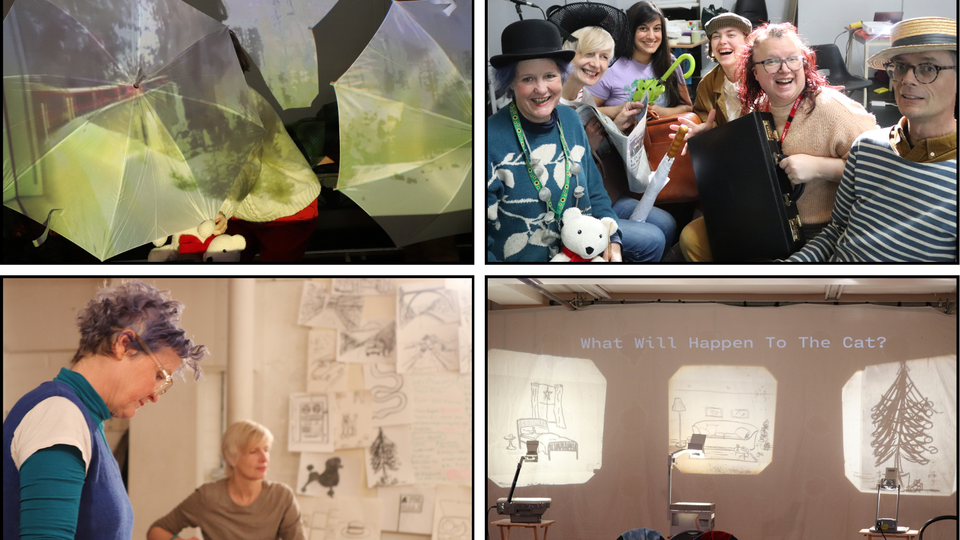
Two weeks ago, I emerged from an intensive period of development of not one but two shows. An increasingly rare and rather nice problem to have, albeit tricky to manage, especially with a health condition involving chronic fatigue. This back-to- back was only made possible due to the distinctive way in which we work at Spare Tyre (see my recent blog on the Kinder Producing Model).
The two pieces of work couldn’t be more different from each other.
Vanishing Point is the working title of our next sensory non-verbal show made for and with people living with dementia. For a week we were resident in Scarborough at the Stephen Joseph Theatre, experimenting with objects, costume, smells, space, time, texture, temperature, projection, shadowplay – magicking story out of nowhere. We spent two afternoons learning about what the railways mean to people and gained an introduction, from people with lived experience, into young onset dementia. We came away with the bones of a new show that could tour in 2026/27.
“it felt unusual and great to be part of something where the co-creation elements are authentic and genuinely influencing the work” – collaborating artist feedback
it felt unusual and great to be part of something where the co-creation elements are authentic and genuinely influencing the work – collaborating artist feedback
What Will Happen to the Cat? Is a text-based show with analogue and digital projection. It’s a campaigning piece, opening up the taboo about predatory marriage and financial co-ercion of older people. In the first week of April, we undertook the final stage of development supporting lead artist Lisa Muten in her mission to bring this story based on real events to an audience. An invited audience of 27 people, artists, potential collaborators, venue programmers and professionals working in the charity sector joined us to see our first script-in-hand staging using projection, basic sound and lights to give an idea of what the final piece could be. They also stayed and discussed the project in depth afterwards.
Meanwhile in our production offices one of our Associate Artists David Munns is being supported to work up a new solo show about the power of suggestion and featuring his own highly-skilled magic and mentalism. Online, a team of brilliant and diverse facilitators including a BSL communication support worker holds space fortnightly for miniature creativity and pockets of joy amongst the chronically ill community across the UK. Last year a housing officer came to see our sensory show “On the Beach” because she’d funded some of the workshops that went with it. She was blown away that it was such a “powerful and poignant” piece of art.
A few days after the recent work in progress sharing, I read another article, one of several in the last 2 years, that have implied that what we at Spare Tyre– and other companies like us– do, is not art. It makes me sad that my colleagues in leading institutions are so siloed in their thinking and experience that they don’t value what we do, as much as the audiences we do it with and the artists who work with us do. I’m sad because it also means they don’t value those people as equal citizens, for whom art is a human right.
For nearly 30 years, I’ve been working in theatre and performing arts in an array of contexts from the Almeida, to Exeter Northcott, directing in Denmark and Norway, to adapting Ibsen with the first-ever gender-flipped Dr Stockman, touring in church halls & schools and now I create original works for care settings alongside what will be a blazing piece of new writing. I can do, and I do do this because I’ve never accepted and never will, that we aren’t all part of the same arts world from a pop-up space in a barn to the main stage at the Royal Opera House. I bring and I insist that all collaborators working with me bring as much rigour, joy, inventiveness and risk-taking as you will see at any of the high profile and national institutions. I know that many of my peers in participatory arts do too.
We create great art and at Spare Tyre our part of the everyone are older people, especially people living with dementia, carers, adults who don’t fit and whose stories get left behind or overlooked. For that art to be authentic and true to its mission, it has to be co-created and participatory.
If you don’t understand how this work is art – you need to get out more.
I said above that I was saddened and mostly I’m sad because in a time of scarcity when the real problem is lack of public investment from governments since 2010, certain colleagues are seeing us as something other, less than, and not part of this glorious and messy ecology that is the world of art. Which is why – controversial as it might be – I am grateful for the Let’s Create strategy, despite its clunky language and the awful, awful spreadsheets and crushing bureaucracy that came with it. I am grateful because of the visibility it brings us, for the redressing of the social injustice that has locked so many people out of arts participation. It is, in my opinion, an idea whose time has come.
Like many people this week I’ve invested more than a few hours in the ACE review survey (deadline midday 24th April) and I’ve been frank and honest in my opinions about how ACE has made some decisions recently. But I speak as a critical friend who knows the value of an arm’s length body. I speak as someone who knows that we’re all in the same storm but some boats are better equipped than others, and the first rule of the sea is to rescue souls in distress not abandon each other.
So I’d ask all my colleagues to take part in the survey, be careful what you wish for, and to everyone I say, as I once said at an interview to a person who had "never seen a CV quite like mine” - if you don’t understand how this work is art – you need to get out more.